
PROGRAM
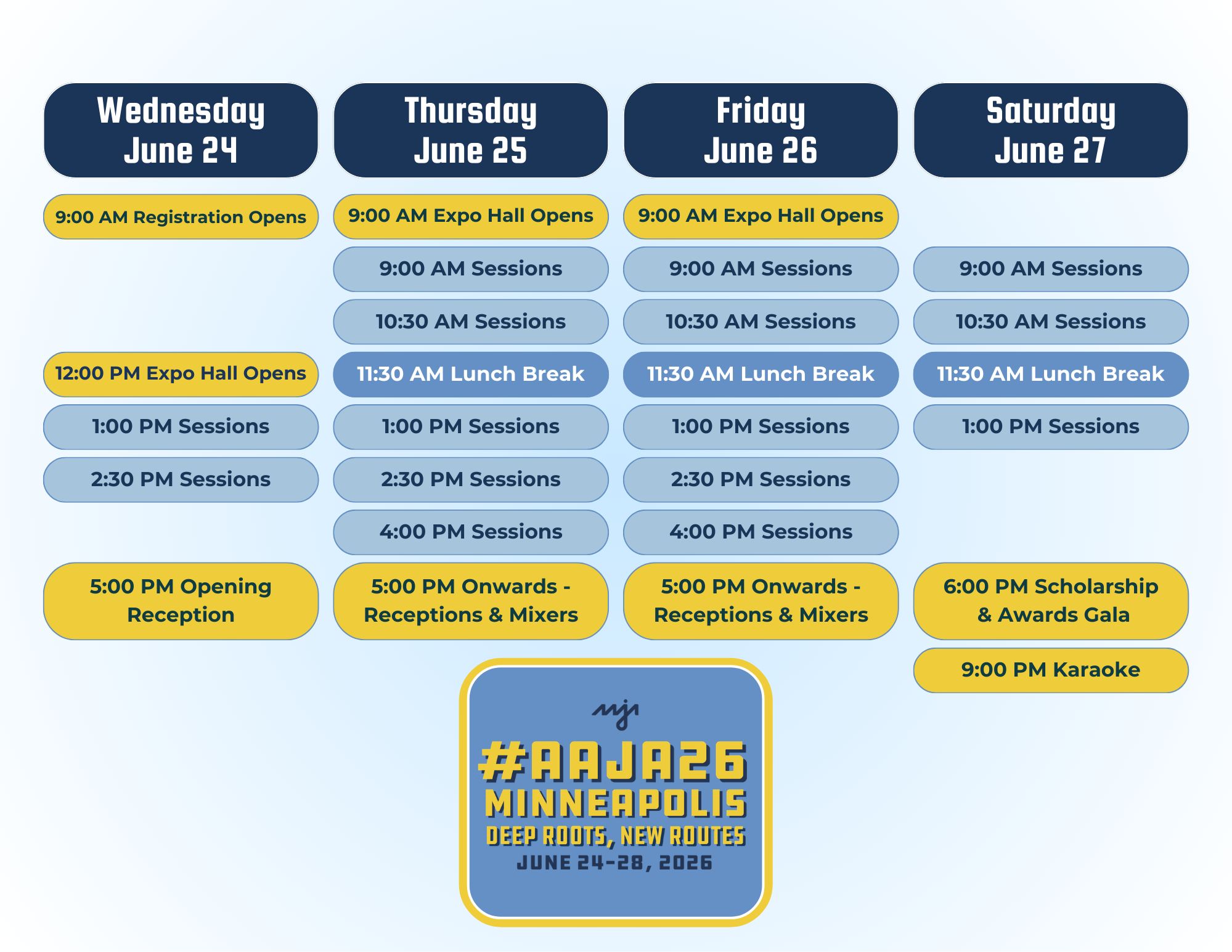
Explore the #AAJA26 schedule
Session descriptions out now!
Sessions will be released on a rolling basis.
Explore our tracks: Community | Innovation | Leadership | Relevance | Resilience
COMMUNITY
-
Trust in journalism and civic institutions is at a historic low. While accountability reporting remains essential, decades of problem-focused political and policy coverage have often left audiences feeling overwhelmed, disengaged and disconnected from their own power.
At the same time, communities across the country are responding to shared challenges through mutual aid, grassroots organizing and local civic and economic action — work that is often undercovered or treated as secondary to traditional political or policy reporting.
This hands-on workshop introduces solutions journalism as a rigorous, evidence-based approach to covering civic life. It centers community knowledge, documents how people exercise local civic and economic power and helps audiences understand how change happens on the ground.
Participants will explore how shifting from problem-only narratives to response-driven reporting can rebuild trust, elevate underrepresented voices and increase journalism’s relevance — especially for Asian American communities and other communities of color that are often flattened or ignored in mainstream coverage.
Through real-world case studies and practical exercises, participants will learn how to identify, report and pitch solutions-focused stories on civic life, local government, elections, local economies and social movements — without sacrificing accountability or rigor.
-
In an era of unprecedented access to conflict, disaster and human suffering, journalists — especially those working with visual media — face relentless exposure to traumatic imagery that can take a profound toll on our mental health. We shouldn’t have to endure the stress, fatigue and burnout from engaging with this content alone while continuing to do our jobs. This interactive panel brings together journalists and mental health professionals to examine the psychological impact of constant visual trauma exposure and explore strategies for building resilience without losing our empathy. Panelists will share their experiences and discuss both the warning signs and practical tools attendees can utilize to protect their mental wellbeing in today's 24/7 news cycle. The session will also provide an opportunity for attendees to exchange their own coping mechanisms and build peer support networks.
-
From World Cup coverage, including questions over whether Iran's matches should be moved out of the U.S., to Olympic debates over representation, including figure skater Alysa Liu competing for Team USA while Eileen Gu chose to represent China, to the WNBA’s collective bargaining negotiations for fair wages, to national headlines surrounding transgender swimmer Lia Thomas, sports stories have become cultural flashpoints. This panel examines the editorial decisions that shape these defining moments, from headline framing and source selection to the historical context that is included or omitted. How do journalists cover complex, emotionally charged events while resisting oversimplification and at the same time provide clarity, nuance and context? And in an era of instant reaction, how can newsrooms slow the narrative down enough to ensure their coverage adequately informs the public?
-
For many AAPI journalists — and particularly queer and trans reporters — proximity to their own communities is often framed as bias rather than expertise. At the same time, traditional notions of “journalistic objectivity” are being reexamined in today’s complex media landscape.
This panel explores how journalists can thoughtfully integrate community engagement into reporting while maintaining rigor and credibility through movement journalism. Drawing on historical and contemporary examples — from Ida B. Wells to modern independent outlets — panelists will share strategies for reporting responsibly, building trust and meeting the information needs of underrepresented communities. They will also discuss how journalists can use their platforms to shape narratives that reflect the holistic lived experiences and knowledge of marginalized communities.
From multilingual reporting and local archives to tailored outreach for mobile or transient populations, movement-informed approaches offer practical lessons for journalists navigating high-stakes or sensitive coverage. This session highlights how journalists can connect with audiences meaningfully, helping the profession meet this moment.
Presented in partnership with the AAJA LGBTQIA+ Affinity Group, this session highlights the next generation of journalists shaping thoughtful, community-informed reporting.
INNOVATION
-
Here, there and everywhere, democracy is under fire. For Asian American journalists working both domestically and in newsrooms in Asia, it’s an opportunity to reflect. There are youth-led movements across Asia that our colleagues overseas have covered and learned from, particularly as Asian newsrooms have innovated and continued operating despite restrictions. In the U.S., journalists in big and small markets across the country are grappling with their own pressures from the current wave of anti-establishment sentiment at all levels of government. Join us for a conversation about what we have in common: resilience under press freedom constraints.
-
Vertical video has become one of the fastest ways to reach new audiences, but doing it well requires more than just hitting records. How do journalists create compelling 60-second social videos that protect journalistic integrity in fast-paced environments, build meaningful audience connections and create sustainable workflows that don’t cause burn out? This panel breaks down the fundamentals of writing tight, effective scripts meant for short-form vertical video, crafting strong hooks that stop the scroll and developing a confident on-screen presence. Panelists will share guidance on how to seamlessly integrate vertical video into daily field reporting by utilizing practical video formats and editing hacks. Panelists will also share strategies for increasing engagement metrics.
-
In a world increasingly filled with AI-generated reports and imagery of uncertain origin and accuracy, news organizations are reaffirming a core principle: humans remain responsible for the journalism they publish. But it isn’t an all-or-nothing proposition. As AI becomes a defining workplace issue in the journalism industry, many newsrooms are doing the work now of developing policies, training and experiments that help journalists work more efficiently while strengthening transparency, verification and human oversight. This session will walk through real-world case studies, along with practical do’s and don’ts that you can apply in your own newsroom as we face a new frontier.
-
In today’s fast-moving news environment and with the rise of artificial intelligence, verifying information quickly and accurately is more critical than ever. This hands-on workshop from AFP’s digital verification specialist will introduce journalists to open-source investigation tools and techniques. Participants will learn how to authenticate photos, videos and social media content, with a focus on the Invid Verification plugin — a free toolkit co-developed by AFP. Whether you’re reporting locally or internationally, this session will equip you with practical skills to ensure your reporting is accurate, credible and trustworthy.
LEADERSHIP
-
From hospitals and university foundations to advocacy groups and pass-through shell organizations, “nonprofit” is not always what it seems. This workshop will give you the tools you need to dig into their annual Form 990 tax filings to uncover whether they're barely keeping afloat and bleeding cash reserves or taking home big executive salaries without giving back to the community as part of their nonprofit mission. We’ll also share tips and tricks on how to navigate other databases bases and resources like annual reports.
-
In a fast-paced media landscape, strong editing skills are essential for producing clear, compelling and accurate journalism. But most of us aren’t taught how to edit; we learn by doing and often new editors are left to wing it.
This session brings together experienced POLITICO editors to explore best practices for editors and those interested in editing — from structural revision to line-level polish, whether you’re working on breaking news or long-form features.
We’ll discuss how to sharpen your news judgment, maintain voice and accuracy and approach editing as both a creative and ethical discipline. This session offers practical strategies and real-world insights to elevate your editing and better understand what editors do.
-
In today’s fast-changing media landscape—marked by layoffs, shifting platforms and unpredictable algorithms—journalists can’t rely only on traditional outlets to build long-term careers. This workshop explores how a personal newsletter can help you own your audience, strengthen your independence and create more career stability by building direct, trusted relationships with readers. We’ll also cover how to turn that audience into a sustainable media product. Participants will learn a “niche-to-scale” approach to identify overlooked angles or communities in any field and shape them into a clear editorial focus. The session will also touch on monetization strategies—including subscriptions, sponsorships and premium content—so journalists can treat their expertise as something they own, grow and sustain over time.
-
Today’s audiences are increasingly discovering news through visually driven platforms, making collaboration between audience and visual teams more essential than ever. This session brings together visual editors and audience directors to explore how newsrooms are breaking down silos to better align visual storytelling with audience growth strategies.
Panelists will share practical ways teams are working together—from social-first visual formats to community-centered visual projects—to create more engaging and impactful journalism. The conversation will highlight new approaches, lessons learned and what it takes to build stronger collaboration between these two critical newsroom functions in a rapidly evolving media landscape.
-
The U.S. depends on the mightiest newsrooms to call election races up and down the ballot so the world can find out who got the votes. This year, most mainstream newsrooms will use the Associated Press’s data to guide them on Election night so they can then inform their readers, watchers and audiences. As the nation gears up for the 2026 Midterm Elections, hear from the pros on what it takes to pull off this integral role of democracy in America and what previous lessons have steeled them to be ready and steady on a potentially turbulent Election Night.
RELEVANCE
-
Tariffs, inflation, interest rates and artificial intelligence dominate headlines but audiences often struggle to understand how these economic forces affect their daily lives. How can journalists translate complex economic shifts into stories that matter to their communities? This panel explores how reporters, on a local and national level, can make business and economic coverage relevant, accessible and impactful. We’ll discuss how to identify story angles that connect policy decisions to everyday costs like groceries, rent and small business survival. Panelists will share practical strategies for finding compelling data, tracking policy impacts, identifying the right voices and turning complicated economic trends into clear, engaging stories that resonate with audiences.
-
Whether you’re early in your career, mid-career, or navigating the later stages, this panel will help you take control of your professional narrative. Too often, journalists rely solely on resumes or LinkedIn, when a portfolio can more fully showcase your story and professional identity. This panel is designed for reporters, producers, assignment editors, managers and more, to walk you through building a dynamic portfolio that highlights not just your news pieces, but your editorial judgement, growth and impact. No tech expertise is required! We’ll cover how to create a polished site using free website builders. And panelists will share how to effectively communicate expertise as well as strategies for standing out in a competitive field. Already have a portfolio? You’ll have a chance to submit it in advance to receive supportive and constructive live feedback during the session. Your career has depth. This panel will help you present it with clarity, confidence and purpose.
-
Documenting yet another national political reckoning, local journalists across the Twin Cities and hundreds of rural towns throughout Minnesota provided up-to-the-moment coverage of ICE operations in 2026. From the galvanizing deaths of Renee Macklin Good and Alex Pretti, to navigating shifting narratives presented by the federal government and now life and business as usual (or not) in the aftermath, hear about their reporting and editorial decisions as they covered the events, verified the facts and took on the troves of videos and photos pouring into their newsrooms.
-
Genre-bending hits like KPop Demon Hunters signal how expansive and commercially viable the AAPI pop culture space has become. Before this there was Crazy Rich Asians, Shogun, Squid Game and anime sensations like Demon Slayer and The Apothecary Diaries, along with global music powerhouses like BLACKPINK and BTS. But how did we get here? And what does this moment require from newsrooms? This panel brings together experts across entertainment, journalism and media strategy to break down how reporters help identify and explain the zeitgeist, engage and build audiences along the way and are integral to closing the gaps for culturally-sensitive reporting.
-
True crime storytelling is one of the most popular genres in podcasting, fueled by audiences eager to analyze evidence, unpack motives and follow cases episode by episode. Journalists on the frontlines of this beat are uniquely positioned to shape how these stories are told. But how can print and digital crime journalists sustainably expand their daily coverage from headlines to podcasts? This panel breaks down practical pathways for podcast storytelling, how to launch a podcast from scratch and strategies for attracting listeners and building long-term audience loyalty. Panelists will also examine the responsibilities that come with this work: understanding the complexities of the justice system, practicing ethical storytelling and balancing narrative tension while resisting sensationalism.
-
Whether you’re new on air or a seasoned pro, you'll learn how to sound more present, natural and engaging — and moving from being heard to truly being listened to. You’ll hear from audio and engagement journalists to explore the difference between voice and speech, how writing choices affect delivery and how small shifts in pacing, pitch and emphasis can change how your reporting lands.
-
The second presidency of Donald Trump has upended norms and legal understandings regarding the ability of journalists to do their jobs without retaliation from federal and state governments. This workshop will discuss how reporters and news organizations are navigating—or failing to navigate—these threats and challenges while exercising their First Amendment rights.
-
Reporting in the field increasingly exposes journalists to complex safety challenges — from covering protests to navigating surveillance technologies and law enforcement encounters in cities like Los Angeles, Chicago, Minneapolis and beyond. Recent conversations among journalists have underscored urgent concerns, including how to safely navigate interactions with Immigration and Customs Enforcement and how to distinguish between different law enforcement agencies on the ground.
Join the International Women’s Media Foundation (IWMF) and the Journalist Assistance Network for a practical session focused on assessing and managing these risks. Safety and legal experts will share strategies for mitigating on-the-ground threats, along with practical guidance for covering protests and high-risk situations. Attendees will leave with concrete, actionable tools to help them report safely in volatile environments — so they can document critical stories without compromising their personal security.
-
Steve Padilla, editor of Los Angeles Times’s storytelling showcase Column One, shares sentence-level techniques to make your writing brighter, tighter and more effective. Drawing on examples from Column One, literature and television, he offers practical tips you can apply to daily stories and long-form narratives. Topics include anecdotal ledes, narrative structure and trimming for clarity and impact. This lively, humorous session may change how you approach your writing.
RESILIENCE
-
As national attention fades from the Maui wildfires, California wildfires and other climate-driven disasters, critical questions remain about how journalists sustain coverage of recovery and keep local communities at the center of the story. This panel brings together reporters and editors to examine what responsible, community-driven reporting looks like after a crisis—when the cameras leave but the rebuilding continues. The conversation will explore lessons from covering Maui’s firestorm and its aftermath, alongside California wildfires and other climate disasters, including how to report with care and accountability, how to elevate local voices and how Pacific Islander journalists have shaped newsroom coverage during pivotal moments. Panelists will also reflect on how newsrooms can better support sustained, on-the-ground reporting and avoid the cycle of attention and erasure that often follows major disasters.
-
A journalist’s job is to report the facts and these facts often include statements from government officials. That task becomes exponentially more difficult when those sources distort the truth to sell their own version of a story. How do newsrooms accurately report what government officials are saying without giving credence to lies, or centering false information in a story? And how do reporters, especially immigrant and POC journalists, accurately cover the Trump administration without risking detention or harassment?
-
“Staggering” and “devastating” were the words that the Washington Post Guild used to describe the impact of the paper’s February layoffs. Similar waves of job cuts have rippled across the industry, from CNN and TIME to Voice of America, underscoring the instability facing journalists nationwide. This panel will focus on survival and strategy. Panelists will discuss how journalists can increase their visibility and demonstrate value before cuts happen, what to do if they’re laid off, how to manage mental health during a job search, freelance reporting and grant opportunities, as well as identifying transferable skills that open doors beyond traditional newsrooms.
-
Step aside, influencers! Journalists have always strategically leveraged their beat expertise into book deals, whether that’s coverage that inspires works of fiction, or nonfiction informed through reporting and sourcing and even cook books that tell the story of our cultures. From planting your flag as “the” authority on your subject area, to navigating the pitching process to sell your idea and finally: getting it over the finish line to Pub Day, hear from your fellow journalists who have done it while staying in or getting out of the journalism day job that led them there.